
Have you noticed that your jawline looks less defined than it used to? Perhaps the skin around your lower cheeks has started to sag, creating small pouches near the corners of your mouth. These changes, commonly called jowls, can develop gradually as the skin and underlying facial structures change with age.
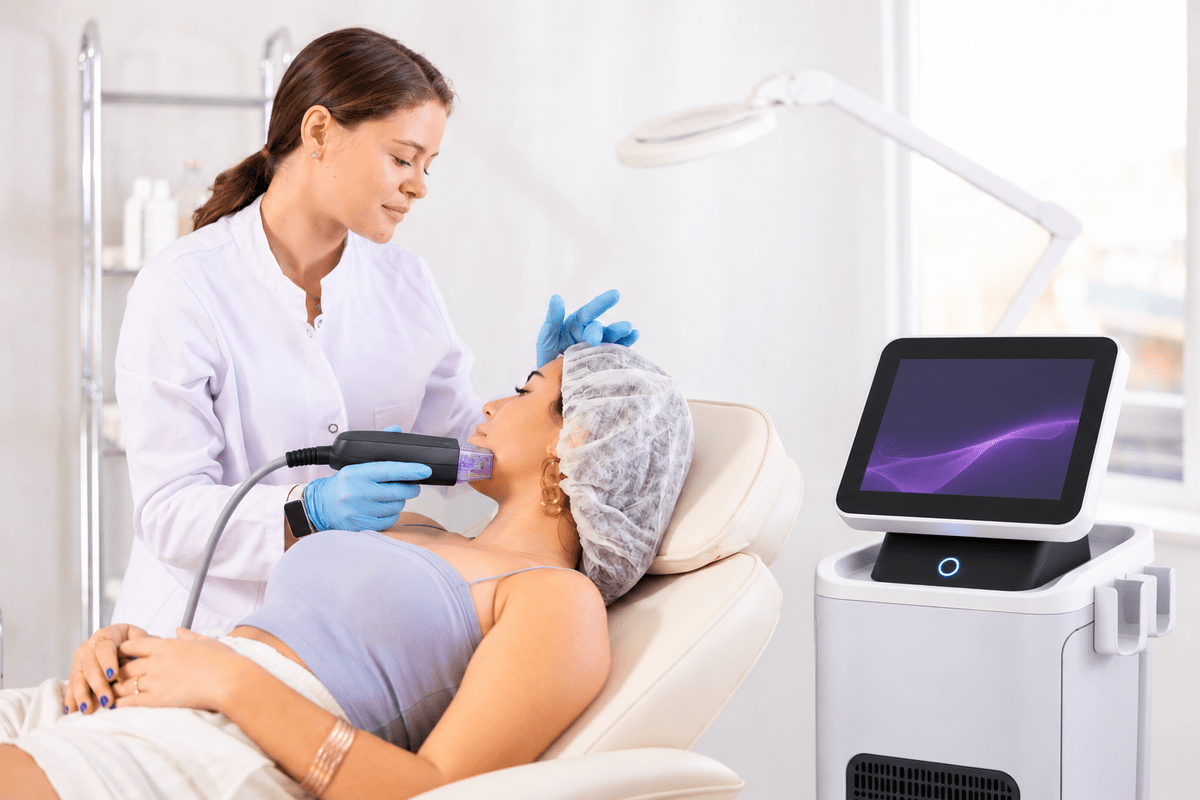
If you want to improve your jawline without immediately considering surgery, you may be researching skin tightening for jowls as a possible option. Radiofrequency treatments use controlled energy to heat targeted tissue and encourage remodeling, which may improve firmness in appropriately selected patients.
However, not all jowls respond equally to non-surgical treatment.
In this article, we explain how radiofrequency technology works, what improvements may be realistic, and when other treatments may be more appropriate. You can also explore Luxora skin tightening at Infinity Wellness to learn about Morpheus8 and QuantumRF.
Jowls develop when tissues along the lower face begin to lose some of their original support and definition.
Your jawline depends on several structures working together, including skin, connective tissue, fat compartments, and underlying facial anatomy.
As these structures change, the lower cheeks may appear heavier or begin to extend below the natural jawline.
Several changes may play a role:
Collagen and elastin changes: These proteins help maintain skin strength and elasticity. Their quality and organization change with aging.
Facial volume changes: Fat compartments can shrink or shift, affecting the support beneath the skin.
Gravity: Over time, changes in tissue support may make downward movement more noticeable.
Sun exposure: Long-term ultraviolet exposure can contribute to the breakdown of supportive skin structures.
Genetics: Facial anatomy and inherited characteristics affect how early jowls become visible.
Weight fluctuations: Significant changes in weight can alter facial volume and skin elasticity.
These changes often occur together rather than independently.
For example, someone may have relatively healthy skin but notice jowls because of changes in facial volume and structural support.
Another person may experience visible sagging mainly because the skin has become less elastic.
Understanding the underlying cause matters because different problems may require different treatments.
Learn more about jawline definition and jowls to understand how these changes can affect the appearance of your lower face.
Radiofrequency treatment may improve mild to moderate skin laxity in certain patients, potentially making the jawline appear firmer or better defined.
The technology works by delivering controlled heat to targeted tissue, depending on the device and treatment method.
This heating may stimulate tissue remodeling and collagen-related changes over time.
However, radiofrequency treatment does not physically remove substantial excess skin or restore every type of lost facial support.
According to a 2025 clinical study available through the National Library of Medicine’s PubMed, researchers observed improvements in jawline sagging after monopolar radiofrequency treatment in a small group of patients.
The study involved 32 participants and evaluated changes in facial skin laxity over time.
Although these findings are encouraging, the study was relatively small and used a particular radiofrequency technology. Its findings should not be interpreted as proof that every RF device, including Morpheus8 or QuantumRF, will produce the same results.
For patients considering skin tightening for jowls, the most important question is whether the visible concern comes primarily from loose skin or from deeper changes in facial structure.
A professional assessment can help determine what level of improvement may be realistic.
Radiofrequency technology uses electrical energy to produce heat within targeted tissue.
The exact depth and method of energy delivery depend on the device being used.
When appropriately administered, RF treatment may trigger a remodeling response that contributes to changes in skin firmness over the following weeks or months.
Collagen helps provide structure and support to the skin.
As collagen changes with age, the skin may become less firm and more prone to sagging.
Radiofrequency treatment creates controlled thermal effects that may encourage tissue remodeling.
However, results vary depending on treatment settings, tissue characteristics, and the individual’s biological response.
The lower face contains important nerves, blood vessels, fat compartments, and other anatomical structures.
Changes in facial volume may also contribute significantly to jowls.
Because of this, treatment must account for more than the appearance of the skin’s surface.
An inappropriate treatment approach could produce an unsatisfactory result or potentially affect underlying tissue.
When researching skin tightening for jowls, it is important to choose a qualified provider who understands facial anatomy and the risks associated with the technology.
For more information about aging-related skin changes, read our article on the causes of sagging skin.
Infinity Wellness offers Morpheus8 and QuantumRF as part of its Luxora skin tightening program.
Both use radiofrequency energy, but they employ different treatment methods.
Understanding these differences can help you prepare for a consultation.
Morpheus8 combines microneedles with radiofrequency energy.
The needles deliver energy to selected tissue depths, producing controlled heating.
Depending on the treatment area and individual assessment, Morpheus8 may be considered for concerns such as:
Mild to moderate skin laxity
Uneven facial texture
Fine lines and wrinkles
Certain acne scars
Reduced firmness around the lower face
Treatment depth and energy settings require careful selection, particularly around the face.
Because the procedure involves microneedles and heat, temporary redness, swelling, tenderness, and other side effects may occur.
QuantumRF is another radiofrequency technology available through Infinity Wellness.
It uses a different method of delivering radiofrequency energy to targeted tissue.
The procedure, treatment depth, expected recovery, and suitability for the jawline should be confirmed with the provider based on the specific applicator used.
Patients should not assume QuantumRF involves the same treatment technique or recovery experience as Morpheus8.
There is no universal answer.
The appropriate technology depends on your anatomy, skin laxity, medical history, and treatment goals.
When comparing skin tightening for jowls with different technologies, focus on the expected benefit, potential risks, and whether the procedure addresses the actual cause of your concerns.
For a more detailed comparison, read our guide to Morpheus8 vs. QuantumRF.
Not everyone with jowls is an appropriate candidate for radiofrequency skin tightening.
Generally, individuals with mild to moderate skin laxity may be better candidates than people with substantial skin and tissue descent.
However, suitability requires an individual assessment.
Your jawline has started losing some definition.
You have mild to moderate skin looseness.
Your main concern involves skin firmness rather than significant excess tissue.
You understand that results may be gradual and subtle.
You have realistic expectations about non-surgical procedures.
Your medical history does not present a reason to avoid treatment.
You have pronounced jowls or substantial excess skin.
Facial volume loss is a major contributor.
You are expecting a surgical facelift-like result.
You have an active skin infection or another relevant medical concern.
Your provider identifies a risk that makes RF treatment unsuitable.
A consultation should include an evaluation of skin quality, facial contours, and the amount of tissue descent.
The best candidate for skin tightening for jowls is not simply someone who wants a sharper jawline, but someone whose concerns can reasonably be addressed by the proposed procedure.
One of the most important parts of treatment planning is understanding what radiofrequency technology can and cannot accomplish.
For appropriate candidates, possible improvements may include:
Modest improvement in skin firmness
A slightly more defined lower-face contour
Reduced appearance of mild skin laxity
Improvement in selected skin texture concerns
A smoother-looking transition between the cheeks and jawline
These changes may be gradual rather than immediately noticeable.
Radiofrequency procedures cannot reliably:
Remove substantial amounts of hanging skin
Reposition facial tissues like a surgical facelift
Restore significant lost facial volume
Eliminate all jowls
Prevent future age-related changes
Produce the same result for every patient
When evaluating skin tightening for jowls, it is useful to distinguish subtle firming from major lifting.
Someone with early skin laxity may consider a modest improvement worthwhile. Another person with prominent jowls may be dissatisfied with the same degree of change.
Your provider should explain what results may be achievable before recommending treatment.
The number of radiofrequency treatments depends on the device, treatment plan, and individual response.
Some protocols involve a series of appointments, while others use a different schedule.
Infinity Wellness describes a typical Luxora treatment plan involving approximately three appointments spaced several weeks apart, although each patient’s plan is individualized.
Your provider may consider:
Severity of skin laxity
Treatment technology
Treatment settings
Skin thickness and condition
Response to previous procedures
Recovery between appointments
Desired improvement
Skin remodeling takes time.
Some patients may begin noticing changes over the following weeks, while additional improvements may develop over several months.
The timeline differs depending on the procedure and how your skin responds.
Patients considering skin tightening for jowls should avoid judging the final result immediately after treatment, particularly when temporary swelling affects the appearance of the jawline.
Some patients choose additional treatment as their skin continues to age.
However, there is no universal maintenance schedule, and additional procedures are not automatically appropriate for everyone.
Your provider can reassess your skin and discuss whether further treatment is likely to provide a meaningful benefit.
Radiofrequency procedures involve potential risks, and safety should be considered alongside cosmetic goals.
Different devices have different treatment methods and recovery requirements.
For RF microneedling procedures such as Morpheus8, temporary side effects may include:
Redness
Swelling
Tenderness
Temporary dryness or roughness
Pinpoint treatment marks
Changes in pigmentation
Although many reactions improve as the skin heals, more serious complications are possible.
According to the U.S. Food and Drug Administration’s safety communication on RF microneedling, serious complications have been reported with certain uses of these devices, including burns, scarring, fat loss, disfigurement, and nerve damage.
These reports highlight why treatment selection and provider training matter.
The jawline depends partly on the distribution of facial fat.
Excessive or unintended fat loss can change facial contours and may worsen certain aesthetic concerns.
For this reason, skin tightening for jowls requires careful consideration of treatment depth, energy delivery, and individual facial anatomy.
It is important not to assume that stronger treatment settings will automatically produce better results.
Seek medical advice if you experience:
Increasing or severe pain
Blistering or signs of burns
Unexpected or persistent numbness
Worsening swelling or redness
Drainage or signs of infection
Unusual changes in facial appearance
Your provider should explain expected recovery, aftercare, and warning signs before the procedure.
Radiofrequency treatment is only one possible approach to improving lower-face appearance.
For some patients, other procedures may address the underlying concern more effectively.
When facial volume loss contributes to a less defined jawline, a qualified provider may discuss whether dermal fillers are appropriate.
Fillers add volume rather than tighten loose skin, so they address a different problem.
They also carry risks, including rare but serious vascular complications.
Depending on your anatomy and goals, a provider may discuss other approaches to facial rejuvenation.
Each treatment has different benefits, limitations, and safety considerations.
For significant jowling or substantial skin and tissue descent, surgical procedures may produce more meaningful changes than non-surgical skin tightening.
A consultation with a qualified facial plastic surgeon or plastic surgeon can help clarify whether surgery is the more appropriate approach.
The goal is not to choose the most intensive treatment available. It is to identify an option with a reasonable balance of expected benefit, risk, and recovery.
Radiofrequency treatment may improve mild to moderate skin laxity, but it cannot guarantee complete removal of jowls. Significant tissue descent or excess skin may require another approach.
Morpheus8 may be considered for selected patients with lower-face skin laxity. However, its suitability depends on facial anatomy, tissue characteristics, treatment goals, and potential risks.
Some patients experience warmth, pressure, or discomfort during treatment. RF microneedling may involve topical numbing. The sensations and comfort measures differ depending on the technology used.
Results may develop gradually over weeks or months as tissue remodeling occurs. The timing varies, and not everyone will achieve noticeable improvement.
An unsatisfactory cosmetic outcome is possible. Certain RF microneedling procedures have been associated with serious complications, including fat loss, which may negatively affect facial contour. Discuss these risks with a qualified provider before treatment.
Neither option is best for everyone. Non-surgical treatments may be suitable for modest improvements in selected patients, while a facelift can address more substantial tissue descent. The appropriate choice depends on your concerns and goals.
Radiofrequency treatment may help improve the appearance of mild to moderate skin laxity around the lower face, but it is not a guaranteed solution for every type of jowling.
The effectiveness of treatment depends on factors such as skin quality, facial volume, underlying tissue support, and the technology used.
For anyone considering skin tightening for jowls, realistic expectations are essential.
Morpheus8 and QuantumRF use radiofrequency energy through different methods, and each treatment requires careful patient selection.
While some individuals may experience improvements in jawline firmness, people with significant excess skin or deeper structural changes may benefit more from other treatment options.
A personalized consultation can help you understand the possible benefits, limitations, risks, and expected recovery before deciding whether a procedure is right for you.
Jowls develop through a combination of skin laxity, facial volume changes, aging, and gravity.
Radiofrequency treatments may improve mild to moderate skin looseness in appropriately selected patients.
Morpheus8 and QuantumRF use different approaches to delivering radiofrequency energy.
Results are generally gradual and vary among individuals.
Non-surgical treatments cannot reliably reproduce the lifting effects of surgery.
The number of treatments depends on the technology, skin condition, and treatment goals.
RF microneedling carries potential risks, including serious complications.
A professional evaluation can help determine whether treatment is suitable for your jawline concerns.
If you have noticed changes in your jawline and want to understand your non-surgical options, a consultation can help you make a more informed decision.
At Infinity Wellness, our team evaluates your skin condition, facial anatomy, medical history, and treatment goals before discussing suitable aesthetic treatments.
Our Luxora program includes Morpheus8 and QuantumRF, allowing providers to assess whether radiofrequency treatment may be appropriate for your concerns. Learn more about skin tightening in Brunswick, OH and schedule a consultation to discuss your options, expected results, and potential risks.
This article is intended for educational purposes only and does not replace professional medical advice, diagnosis, or treatment. Radiofrequency skin tightening and RF microneedling have potential risks, including serious complications. Treatment suitability, results, and recovery vary. Consult a qualified healthcare professional to determine whether any procedure is appropriate for your individual circumstances.
A space for feeling and looking your best, inside and out. From weight loss to hormone balance, we blend wellness and aesthetics with a personal touch, right here in Brunswick, Ohio.
© 2026 Infinity Wellness LLC. All rights reserved.
Website Designed by IL Webdesign
All imagery displayed on this website, whether licensed from stock photography providers such as Shutterstock or generated using artificial intelligence, is used strictly for illustrative and educational purposes. Such images are intended solely to visually represent the subject matter described in the accompanying titles and/or descriptions. They do not, in any way, depict actual clients, patients, providers, employees, or other real individuals unless expressly stated otherwise. Any resemblance to a real person is purely coincidental, and no endorsement, testimonial, or representation of services is stated or implied by the use of such imagery.
This site is protected by reCAPTCHA and the Google Privacy Policy and Terms of Service apply.