
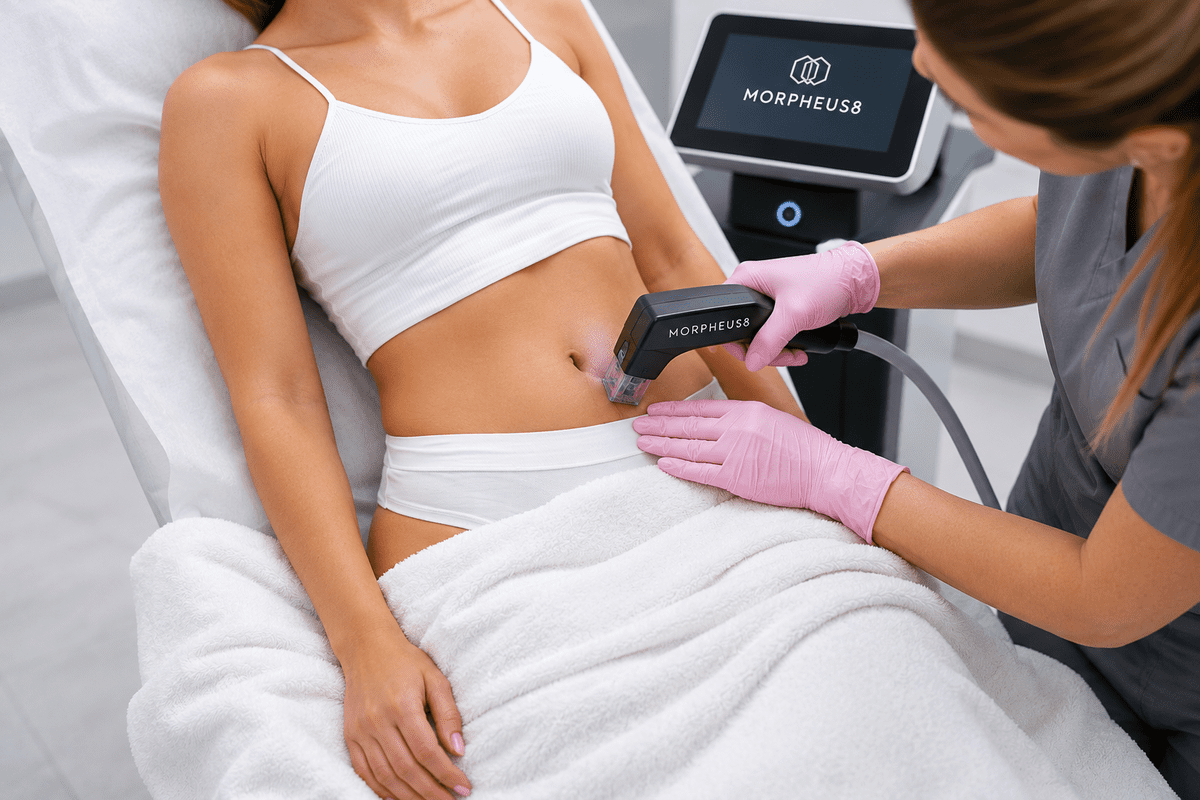
If you are considering treatment for loose skin, fine lines, or a loss of firmness, you probably want to know how many appointments it will take to see a noticeable difference. Radiofrequency treatments can stimulate collagen remodeling, but improvements often develop gradually rather than appearing immediately after your first visit.
The number of skin tightening sessions you need depends on several factors, including your skin condition, the treatment technology used, and your desired results. Some patients may benefit from a series of appointments, while others may need a different treatment approach.
At Infinity Wellness, our Luxora skin tightening program offers Morpheus8 and QuantumRF treatments tailored to individual skin concerns.
This guide explains how treatment plans are determined, why appointments may be spaced several weeks apart, and what to expect as your skin responds.
Skin naturally loses some of its firmness over time. Collagen and elastin, two important components that support the skin’s structure, gradually change with aging, sun exposure, and other factors.
As these changes develop, you may notice:
Softer definition around the jawline
Loose skin on the neck
Fine lines and wrinkles
Changes in skin texture
Reduced firmness around the cheeks
Skin laxity after weight loss
Radiofrequency treatments use controlled energy to heat targeted tissue. Depending on the device and technique, this may encourage tissue remodeling and collagen production.
However, collagen remodeling is a gradual biological process.
Unlike a procedure that physically removes excess skin, radiofrequency treatment generally aims to improve firmness over time. A series of appointments may be recommended when additional treatment is appropriate for the patient’s goals.
The number of treatments should reflect the condition of the skin and the expected benefit, not simply a standard package offered to everyone.
Many patients begin with a treatment plan involving approximately three appointments. However, there is no universal number that guarantees the desired result.
At Infinity Wellness, Luxora treatment plans commonly involve a series of three skin tightening sessions spaced several weeks apart.
Your provider may recommend a different schedule after examining your skin and discussing what you hope to achieve.
People with early changes in firmness may have different treatment needs from those with more noticeable sagging.
A provider may recommend a limited treatment plan and reassess the response before suggesting additional procedures.
When skin has lost more of its elasticity, multiple appointments may be considered to achieve a meaningful improvement.
However, the number of treatments alone does not determine success. The device, treatment settings, skin characteristics, and individual response also matter.
People with substantial excess skin, particularly after major weight loss, may not achieve their desired results with radiofrequency procedures alone.
In these cases, a consultation can help determine whether a different treatment, including a surgical option, may be more appropriate.
The goal is to develop a realistic treatment plan rather than recommend repeated procedures that are unlikely to provide the expected benefit.
Yes. Different radiofrequency technologies use different methods of delivering energy, and treatment plans are not necessarily interchangeable.
Infinity Wellness offers Morpheus8 and QuantumRF through its Luxora program.
Morpheus8 combines microneedles with radiofrequency energy to treat targeted skin tissue.
It may be considered for concerns such as:
Mild to moderate skin laxity
Uneven skin texture
Certain acne scars
Fine lines and wrinkles
Changes in facial or neck firmness
Depending on your skin condition and treatment settings, a provider may recommend a series of appointments.
Because Morpheus8 uses needles and controlled heat, recovery time and the risk of complications should be considered when scheduling treatments.
QuantumRF is another radiofrequency treatment offered through Luxora. It uses a different approach to delivering energy into targeted tissue.
The exact technique, treatment areas, recovery expectations, and number of appointments should be confirmed during your consultation.
The number of skin tightening sessions may therefore differ depending on whether Morpheus8, QuantumRF, or a combination is recommended.
For a detailed explanation of these technologies, read our guide to Morpheus8 vs. QuantumRF.
Not everyone develops loose skin for the same reasons. As a result, two people with similar concerns may need different approaches.
Several factors can influence the recommended skin tightening sessions.
Collagen production and skin elasticity change naturally with age. These changes may affect how the skin responds to treatment.
Mild looseness may be more suitable for non-surgical treatment than substantial excess skin.
A provider will assess whether radiofrequency treatment can realistically address the concern.
The face, jawline, neck, abdomen, and arms have different skin characteristics.
Treatment planning may therefore vary depending on the size and condition of the area being treated.
Weight loss can leave behind stretched skin that does not fully retract.
The amount of excess skin may influence whether non-surgical tightening is appropriate.
Sun exposure, smoking, certain medical conditions, and other factors can affect skin quality and recovery.
If you want to understand why skin becomes less firm, our article on the causes of sagging skin explains the most common contributing factors.
Some patients want subtle improvements in texture and firmness, while others hope to address more pronounced sagging.
A consultation helps determine whether these expectations are realistic for the available treatment options.
It is natural to wonder whether scheduling treatments closer together will produce faster results.
However, more frequent appointments do not necessarily lead to better outcomes.
The body needs time to recover from treatment, and collagen remodeling continues after the procedure.
For this reason, providers typically space skin tightening sessions several weeks apart when a series is appropriate.
Your exact schedule will depend on the device, treatment settings, treatment area, and how your skin heals.
Allowing time between appointments helps your provider:
Assess your skin’s response
Monitor redness, swelling, or other reactions
Determine whether healing is progressing appropriately
Evaluate whether additional treatment is needed
Make adjustments to the treatment plan when necessary
For treatments involving microneedling, your provider will also consider how long the treated skin needs to recover.
Scheduling additional procedures before the skin has adequately healed may increase the risk of complications.
Do not shorten the recommended treatment interval without discussing it with your provider.
Skin tightening results do not always appear immediately after treatment.
Some temporary changes may be noticeable soon after a procedure, but collagen remodeling generally develops over the following weeks and months.
The visible effects of skin tightening sessions depend on how your skin responds and which treatment is used.
You may experience redness, swelling, tenderness, or other temporary treatment-related effects.
These changes should not be mistaken for the final result.
As your skin recovers, you may begin noticing gradual improvements in texture or firmness.
The timing and degree of improvement vary.
Collagen remodeling may continue, and your provider can evaluate whether meaningful changes have occurred.
Photographs taken under consistent lighting can help document progress more accurately than relying on memory alone.
It is important to understand that radiofrequency skin tightening cannot produce the same degree of correction as surgical removal of significant excess skin.
A realistic goal is gradual improvement in appropriate candidates, not an immediate transformation.
Loose skin after weight loss is a common concern, particularly around the abdomen, arms, neck, and jawline.
As body fat decreases, previously stretched skin may not fully return to its original shape.
Several factors influence how much skin remains loose:
Total amount of weight lost
Duration of previous weight gain
Age and skin elasticity
Genetics
Sun exposure and smoking history
Whether body weight has stabilized
Planning skin tightening sessions after weight loss requires careful consideration of how much excess skin is present.
For mild laxity, non-surgical treatments may provide some improvement in firmness.
However, significant folds of excess skin generally cannot be removed through radiofrequency treatment. Surgery may be a more effective option for certain patients.
If you are experiencing this concern, read our article on skin tightening after weight loss to understand when non-surgical treatment may help and when other options should be considered.
A provider can evaluate your skin and explain which results may be achievable.
Even after successful treatment, the skin continues to age naturally.
Collagen and elastin change over time, and sun exposure, weight fluctuations, and lifestyle habits can affect long-term skin appearance.
Some patients choose to discuss additional skin tightening sessions for maintenance after completing their initial treatment plan.
However, maintenance is not automatically necessary for every patient.
Your provider may consider:
How well your skin responded to the initial treatment
Whether your concerns have changed
How much time has passed since treatment
Your overall skin health
Whether another procedure would offer a meaningful benefit
Your preferences and budget
There is no single maintenance schedule that applies to every radiofrequency device or patient.
Regular follow-up appointments can help determine whether additional treatment is worthwhile.
Although skincare cannot replace a medical tightening procedure, several habits can support overall skin health:
Use broad-spectrum sunscreen regularly
Avoid smoking
Maintain a balanced diet
Follow a consistent skincare routine
Avoid significant weight fluctuations when possible
Follow your provider’s aftercare instructions
These measures may support skin health but cannot guarantee that treatment results will last for a particular number of years.
Safety should be part of every skin tightening treatment plan.
Although some people experience only temporary redness or swelling, radiofrequency microneedling carries potential risks.
According to the U.S. Food and Drug Administration’s guidance on microneedling devices, specific microneedling devices are legally authorized for particular uses, and patients should understand the relevant risks before undergoing treatment.
Additionally, according to the FDA’s safety communication on radiofrequency microneedling, serious complications have been reported with certain uses of RF microneedling devices, including burns, scarring, fat loss, and nerve damage.
These reports do not mean that every patient will experience complications. They do highlight the importance of appropriate patient selection, professional training, and careful treatment planning.
Ask your provider about:
The specific device being used
Whether the procedure involves needles or an entry point
Expected recovery time
Potential side effects and complications
How your medical history may affect eligibility
Which symptoms require prompt medical attention
How your response will be assessed before another appointment
Inform your provider about active skin infections, medications, implanted medical devices, previous procedures, and relevant medical conditions.
Contact your provider if you develop unexpected or worsening symptoms after treatment.
Some people may be satisfied with the improvement from a single procedure, depending on their concerns and the device used. However, one treatment is not guaranteed to provide the desired result, and many treatment plans involve multiple appointments.
A series may be recommended because improvement develops gradually and additional treatment may be appropriate after the skin has recovered. Infinity Wellness commonly describes a three-treatment plan, but the exact number is individualized.
Weekly treatment is not appropriate for every procedure. Many radiofrequency treatment plans require several weeks between appointments to allow healing and assess the skin's response. Follow the schedule recommended by your provider.
Not necessarily. They are different radiofrequency technologies, and the recommended treatment schedule depends on the specific procedure, treatment area, and patient's goals.
You may notice some changes after the first appointment, but visible improvement often develops gradually. Results vary and may continue changing over several weeks or months.
Not everyone needs yearly treatment. Maintenance recommendations should be based on your results, skin condition, preferences, and whether additional procedures are expected to provide a worthwhile benefit.
If you are considering radiofrequency treatment for loose or aging skin, knowing how many appointments you may need can help you prepare for the process.
At Infinity Wellness, a typical Luxora treatment plan may involve approximately three appointments spaced several weeks apart. However, this is only a general starting point.
The right number of skin tightening sessions depends on your treatment technology, degree of skin laxity, recovery, and desired results.
Some people may need fewer procedures, while others may benefit from a different approach altogether.
A personalized consultation is the best way to establish realistic expectations, understand potential risks, and decide whether Morpheus8, QuantumRF, or another treatment is suitable for your needs.
Infinity Wellness commonly describes a Luxora treatment series involving approximately three appointments.
The exact number of treatments depends on skin condition, goals, and the technology used.
Morpheus8 and QuantumRF may require different treatment plans.
Appointments are often spaced several weeks apart to allow recovery and assessment.
Results may develop gradually as the skin undergoes collagen remodeling.
Significant excess skin may require a different treatment approach, including surgery.
Maintenance treatments are individualized rather than automatically scheduled.
A qualified provider should discuss risks, recovery, and realistic outcomes before treatment.
If loose skin, uneven texture, or reduced firmness has started affecting your confidence, a professional consultation can help you understand your options.
At Infinity Wellness, we consider your skin condition, treatment goals, and medical history when recommending an appropriate aesthetic treatment plan. Our Luxora program includes Morpheus8 and QuantumRF, allowing providers to evaluate which technology may be suitable for your concerns. Learn more about skin tightening in Brunswick, OH and schedule a consultation to discuss your treatment options and expected results.
This article is for educational purposes only and does not replace medical advice, diagnosis, or treatment. Skin tightening results, recovery times, and treatment schedules vary depending on individual circumstances and the specific device used. Radiofrequency procedures carry potential risks, including serious complications. Consult a qualified healthcare professional to determine whether treatment is appropriate for you.
A space for feeling and looking your best, inside and out. From weight loss to hormone balance, we blend wellness and aesthetics with a personal touch, right here in Brunswick, Ohio.
© 2026 Infinity Wellness LLC. All rights reserved.
Website Designed by IL Webdesign
All imagery displayed on this website, whether licensed from stock photography providers such as Shutterstock or generated using artificial intelligence, is used strictly for illustrative and educational purposes. Such images are intended solely to visually represent the subject matter described in the accompanying titles and/or descriptions. They do not, in any way, depict actual clients, patients, providers, employees, or other real individuals unless expressly stated otherwise. Any resemblance to a real person is purely coincidental, and no endorsement, testimonial, or representation of services is stated or implied by the use of such imagery.
This site is protected by reCAPTCHA and the Google Privacy Policy and Terms of Service apply.